Showing posts with label Ember Days. Show all posts

Monday, September 14, 2015

Feast of the Holy Cross

Detail of my Summer 2015 Quarter Year Liturgical Calendar
September 14 - The Feast of the Exaltation of the Holy Cross is one of the markers for the seasonal-liturgical calendar year. Holy Cross Day marked the beginning of monastic winter in some communities; the Rule of St. Benedict has a summer and winter schedule for the monks' working, eating, and prayer days, and as the days grew noticeably shorter, this was the point in which the schedule changed over--meals would be lighter since outdoor work would be decreasing. 

"From the Ides of September until the beginning of Lent
let them always take their dinner at the ninth hour.
...
But this evening hour shall be so determined
that they will not need the light of a lamp while eating,
Indeed at all seasons
let the hour, whether for supper or for dinner, be so arranged
that everything will be done by daylight."
--from Chapter 41 of the RSB

Holy Cross Day also is the marker for the Ember Days at the end of of summer, arriving near the autumnal equinox (September 23 this year) and before the next Quarter Day, Michaelmas (September 29). The Wednesday, Friday, and Saturday, following the Sunday after Holy Cross Day (got that?), are the Ember Days, which are days of thanksgiving, prayer and fasting in appreciation of the harvest, the fruits of the earth and the fruits of the Spirit, all of which grow and nourish us, thanks to the grace of God. 

Ember Days at a glance
Reflect & orient oneself to the coming season 
Wednesday: give thanks for the harvest - devotion to Mary
Friday: we ask the Lord to bless our labors - light a candle and pray for the souls of loved ones 
Saturday: anticipating the celebration - pray for priests & vocations

These would be good days for garden clean up, planting new trees (before that first frost hits), preparing for colder and wetter days ahead. I have grapes and basil to harvest, as well as a lot of summer greens to clear up and out. The pumpkins and squash are doing great still, but you can feel the garden starting to die back with less sunlight and more cold days.  

Holy Cross is also my parish, so this is our patronal feast day. One Eastern Orthodox Christian practice I read about for Holy Cross is the veneration of the cross (on the vigil of the feast) by placing a small cross on a tray, surrounded by basil leaves and flowers. This would be part of the feast's liturgy, and would be venerated (kissed) and incensed in a procession. This idea could easily be adapted for home use as part of your family evening prayer time. 


Thursday, February 5, 2015

Early Signs of Spring

There are only six short weeks of Ordinary Time between the Christmas Season and the beginning of Lent. Ash Wednesday is two weeks from today. Are you ready? My Christmas boxes are STILL sitting in the corner of the dining room....

February 1, 2, and 3 are days traditionally associated with looking for spring to arrive. February 1 is St. Brigid's Day. February 2 is Candlemas, more commonly celebrated in the USA on this date is Groundhog Day. February 3 is the Japanese holiday called Setsubun. It's interesting to compare how all these late-winter-but-looking-for-spring holidays are similar.


"February" comes from the Roman "Februa," a purification festival held at this time of year, associated with spring cleaning or washing. Many of the February first festivals have to do with getting rid of winter illnesses. One of my favorite things to do this time of year, when the sun shines on rare occasion and I finally notice all the winter dust on the floors, is to clean while all the windows are open. I turn off the central heat as well and let the house get as cool as it can for a day. (Here, that means it gets down to about 60F without the heat on for 12 hours. Outdoors it is usually 40-50F.) Letting in fresh, frigid winter air is a common way of airing out the house and getting rid of dampness that encourages bacteria to grow. And it just makes everything smell better. 

St. Brigid's Day (Feb. 1) was important to the early Scots and Irish. It is also called Imbolc, and marks the halfway point between the winter solstice and the spring equinox. Unlike the English, who got many of their festival customs from the Romans and so celebrated the quarter days (Dec 25, March 25, June 24, Sept 29), the Scots and Irish seem to have marked the cross-quarter days (Feb 1, May 1, August 1, Nov. 1) with feasting and celebrations. This is also when the rents and repayment of debts were due, and later, when school terms began.


I don't know a lot about Brigid, but supposedly she was a pagan goddess whose legend merged with that of a Christian saint. She's associated with fire (another form of purification), and the blessing of the earth in preparation for new planting. Somewhat similar to leaving out milk and cookies for St. Nick, the ancients would prepare a hospitable welcome for Brigid by making up a bed of hay for her, someone would dress up as Brigid and knock to be let in, and then the blessing and feasting would begin. Hospitality was rewarded with a good planting season. St. Brigit of Kildare was an early Irish (5th C.) monastic and her relics are now in Portugal. There were apparently a lot of early saints named Brigid and their legends and lives have all gotten put together over time. 

February 1 was also ideally the date to begin plowing the fields in England, called Plough Monday, but it could be moved to an earlier or later Monday after Epiphany depending on the weather. The women went back to work earlier (of course), on January 7, Distaff Day, when spinning began again after the twelve days of Christmas holidays. Sometimes Plough Monday and Distaff Day fell on the same day.  
Folk getting up to all kinds of crazy for Plough Monday.

Conspicuously less merriment associated with Distaff Day. 

Candlemas (Feb. 2) is shorthand for the Feast of the Purification, which marks the 40th day after Christmas, when the Virgin Mary, a law-abiding Jewish mother, presented herself for ritual purification at the temple after giving birth to a son. (Giving birth to a girl baby required 80 days of waiting before purification. This has to do with taboos about bodily fluids leaving the body. A menstruating woman, for instance, could not enter the temple.) On this feast day, we remember when Mary presented herself, and met Anna and Simeon, and they recognized Christ as the Light of the World. Thus, the candles of Candle Mass. It became a traditional time to bless all the candles that were made over the long winter to be used in the coming year. Candle-making was a task that could be done in winter because the harvest was done and energy could be given to less essential tasks, like household repairs and handicrafts. Some people wait until this date, the very last gasp of Christmas celebrations, to take down the holiday decorations. 


In the USA, we have Groundhog Day on Feb. 2. The groundhog, a large hibernating rodent, is supposed to be lured from his hole in the ground. If he sees his shadow, spring is on the way. If not, then six more weeks of winter will be expected. (This year, no surprise to many, he did not see his shadow.) The tradition of observing hibernating animals, or by observing the weather of Feb. 1, to forecast the weather is common. In Europe, it was a beaver, wolf, or bear. I think it all comes from eager farmers wanting to know how soon they could plant. There's nothing worse than investing time and energy into planting and having a surprise freeze kill everything in one night. 


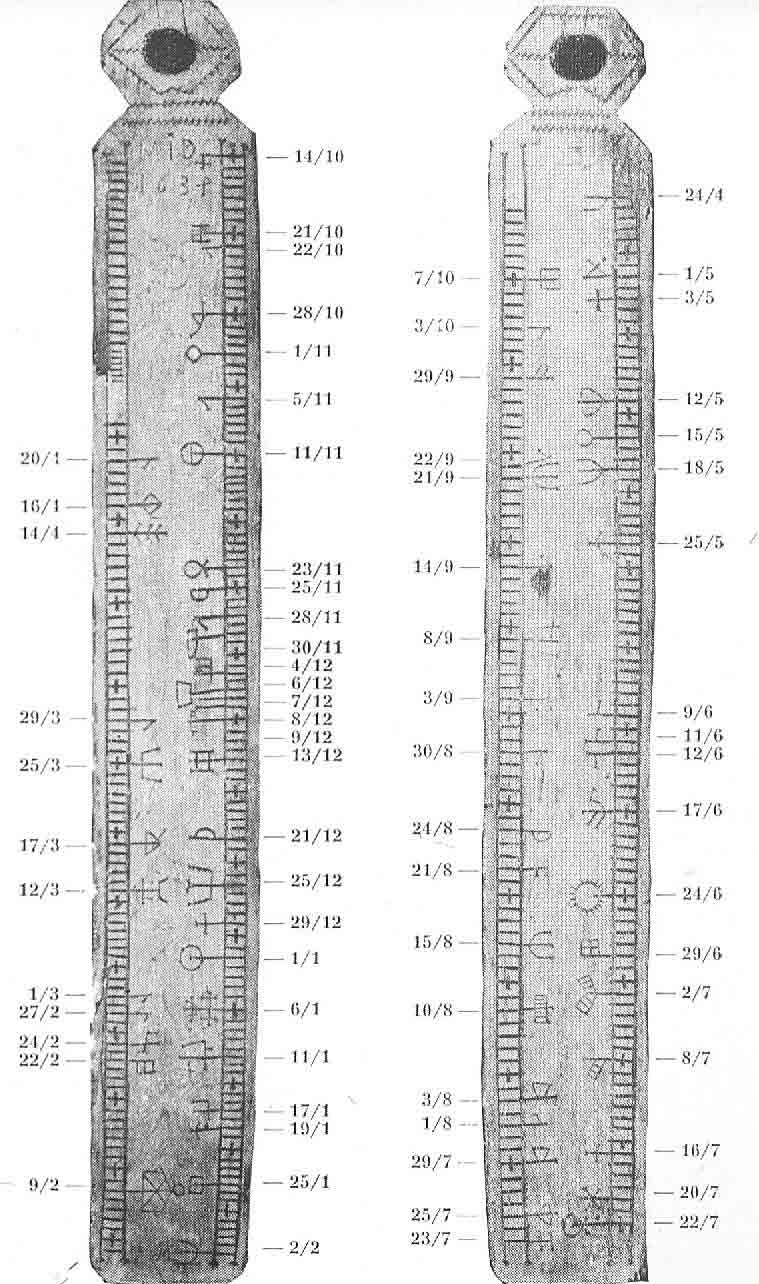
The Scandinavians had a seasonal calendar called a Primstav, or runic calendar. Basically, it is a flat wooden stick (something like a fancy yard stick) with notches and carved runes on two sides, one for winter, one for summer. Many cultures only divided the year into summer and winter. A primstav was a practical decoration for a farmstead and usually hung by the front door. Another translation of primstav is primspell.  Besides the blessing of candles at this time, Candlemas was the halfway point for the winter season and farmers checked their animal feed at this point. Early spring was often a time of great hunger if winter stores were used up too early.

Something interesting I read recently is that St. Valentine's Day, Feb. 14, would have fallen about two weeks earlier in the Julian calendar, Feb. 1. Before he was associated with romantic love, his feast day was associated with the early spring. This may have been the date of his actual martyrdom (he was a Christian priest in a time of persecution) or it may have been one of those situations where his veneration was placed on top of an already important date for the Romans, Februa.

Feb. 3 is St. Blaise's Day and again there is the theme of purification and candles. St. Blaise's story is that he was a physcian, then later a hermit and a bishop, who cured a child that had been choking on a fish bone. The custom on this day was to bless those with throat ailments or other illnesses. Part of the ritual is to hold two long crossed candles around the neck, or in blessing over the congregation. What could be a more appropriate prayer at the height of flu season than to ask God for healing?

Mamemaki is a Japanese ritual that is part of the spring holiday (Haru Matsuri), also marked on Feb. 3. This date is called Setsubun. I only know about this one because a family I am friends with celebrates it every year. They throw soybeans out the front door (or at a family member wearing a mask) and shout "Demons out! Luck in!" and slam the door on last year's bad luck and disease-bringing evil spirits.  

Detail, Winter Quarter Year Calendar
I noticed a giant glaring error on my winter calendar drawing just yesterday! I wrote in the Ember Days of Lent as MARCH 25, 27, and 28. The Lenten Ember Days fall on the Wednesday, Friday, and Saturday after the first Sunday of Lent every year, so obviously it should be FEBRUARY 25, 27, and 28. I always get thrown off because February and March are numbered the same. Oops! Well, it's strange having a series of penitential days within the already penitential season of Lent, but the point of the ember days is the blessing of seasonal work and harvests. If you begin to plow on Plough Monday, then bless the fields after prayer and fasting on the ember days, you will be right on track for planting in March; one of the traditional days to plant potatoes was Good Friday.
February, Tres Riches Heures Duc du Berry
I've been spending my winter indoor work time writing letters, making summer plans, filling up the calendar for fall (in pencil), and of course, spring cleaning. I'm reading through a textbook on Western Civilization, trying to make academic study a daily habit. I'm enjoying it a lot, once I actually sit down and make time for it. The author proposes the idea of the "Greater West" instead of just Western Civilization; meaning, it includes the history of the middle eastern peoples. He argues that despite the schism between Europe and the Near East, these cultures have more in common than Arabia does with Japan or other far eastern regions. I think it's a neat solution to assertions of western civ being only the study of dead white male accomplishments. Fourteen chapters...shouldn't take long, right?


Saturday, December 20, 2014

Come to the Table

Advent Ember Saturday
Anticipating the Holy Day that is coming soon

Prayer (fourth O Antiphon)

R. Alleluia, alleluia.
O Key of David,
opening the gates of God's eternal Kingdom:
come and free the prisoners of darkness!
R. Alleluia, alleluia.

Maybe you, like me, are missing loved ones around the Christmas dinner table, After my husband died in 2010, every time I sat down at the table all I could see was who was missing. To me, it seemed to symbolize what our family could never be again, gathered around the table with father at the head, mother at the foot, and children on both sides.

So for a while, we ate at the kitchen counter or in the living room, on the couch by the television. I've since bought a new table (the old one is now my work table in my office) and this is the first Christmas since his death that it feels like we have hit a new normal, where the overwhelming feeling isn't that someone is missing. That wound is still there, but it has healed over, and we can have a Christmas at home without it being very painful.

I think.

We're still five days away, right? Emotions have a way of sneaking up on you. Even when your head says you are okay, your body can be acting otherwise. But I don't have that feeling of dread I did the past four Christmasses, so I think it will be fine.

Christmas cards ready to go...but feeling too bleh to get to the post office.
Maybe Monday.
I was thinking about my intention last night, to light a candle and pray for the souls of my loved ones. I have a little collection of new votive candles, left over party favors from my son's first communion, actually. I had the idea this morning to make small name labels for each one and set them on the dining table (though they move to the sideboard for the actual dinner) as a way of visibly including their spirit at our Christmas celebration. I will light each one and remember that person with love.

"The light shines in the darkness and the darkness has not overcome it." --John 1:5

Today is the last of the three ember days of Advent, in preparation for Christmas. The first was Wednesday, the next was yesterday, Friday, and you can read about them in those blog posts. The ember Saturdays are for anticipating the celebration of the upcoming holy day. This is not a hard one, there is plenty to do to get ready. In former days, priestly ordinations were held on ember Saturdays, so perhaps including your local priest, seminarian, or other clergy in your prayers and when you write Christmas cards or make holiday party invitations, or put together a nice care package for him to say thanks for all he has done over the past year, would be a kind way to participate in this tradition.

Natural world: tomorrow is the shortest day of the year, the winter solstice, and also a new moon.

Folklore: today's weather was cold, overcast, and sometimes foggy, with rain in the evening. We will see if this will bring us a similar March.

Tomorrow is the Fourth Sunday in Advent. The big day is almost here, whether we are sick or in good health, ready or not, here it comes.

Illus. by Jeanyee Wong, from The Cherry Tree Carol, 1951

Friday, December 19, 2014

Advent Ember Friday

Focus: conversion of the heart; prepare for Christmas with prayer, fasting and almsgiving. 


Put a bird on it.
Christmas is very near, less than a week is left in Advent. The kids are on their last day of school. The shopping must be finished. Packages must be wrapped and mailed. There is a menu to be planned and a lot of eager hungry relatives to be fed. It is easy to get caught up entirely in the frenzy of preparing that comes with the holidays.

The ember days remind us to orient ourselves to the spiritual first and focus on the joy of Christ's coming. In quiet observation of the natural world, we can see that all of creation is filled with signs from God, from the obvious beauty of a clear bright winter day where the snow sparkles in sunlight, to the hidden beauty of a nut tree gone to sleep for the winter in preparation to bear its fruit next year.


As we continue our work throughout the winter months--because even during vacation, children must be fed and dishes must be washed and laundry must get done (or whatever your daily work might be)--we ask the Lord to bless our labors, and put them in his hands for his own use.


Bless my reading, and thinking, and drawing, and writing, Lord; may these activities lead me to holiness, and if they do not, then direct me to other work.


Chapel window at Glacier National Park
Natural World
Sunrise today was at 7:54 a.m. and sunset will be at 4:17 p.m. Only 8 hrs and 22 minutes of daylight. The moon is just a sliver of light, waning crescent and only 7% visible. The longest night of the year is just two days away. This year there will be a new moon on Dec. 21, so the night will be very dark indeed. According to a little internet research, this happens about every three years.

In folklore, today's weather predicts next February's forecast. The weather today was 45'-50'F with very heavy rain showers before noon, a sunny/partly cloudy midday and back to rain for the evening. A cold and changeable February would be no surprise.

Prayer (contemplation, praise, thanksgiving, petition)


R. Alleluia, alleluia.
O Root of Jesse's stem,
sign of God's love for all his people:
come to save us without delay!
R. Alleluia, alleluia.

Apparently, in ancient days, there was a folk belief that the souls in purgatory might appear on ember Fridays to those faithful relatives who prayed for them, to thank them for their prayerful intercession and beg for continued prayers. Some countries have their Halloween-like traditions during this time of year, where children go begging for treats or giving them, and the spirits of those who have passed away are remembered.
Kitchen window icon
I need to pray for my loved ones who have died (or rather, they depend on me to pray for them). As a convert, this is a practice I did not grow up with and am still learning. I appreciate the quarterly reminder of ember days to not forget the poor souls in purgatory. I will light a candle for each of them tonight, and for all those living persons who have asked for prayers recently, and thank God who has "come to save us without delay!"


Fasting (penance)
Keeping in mind that observing ember days at all is optional, there is no requirement to do anything. But if you wish to, you may. On a normal Friday, Catholics are asked to make an act of penance; the traditional way is to abstain from meat. But you can also do something different. Make an examination of conscience and pray the act of contrition, go to confession (if available today or tomorrow). A little bit of fasting before all the Christmas feasting begins makes everything feel balanced, I think. Temperate.


My "Word of the Year" for 2014
Almsgiving (charitable good work)
I am grateful that I always have food enough in the pantry to feed my family. Today would be a good day to make a donation to the church, either from the cupboards or financial, to help those who do not have enough for their families. This is probably something you do already, but the Ember Friday is like a note that says, "Don't forget the poor and needy!"

Our advent wreath in 2009.
Tomorrow is the last of the ember days for Advent. They come four times a year to bring in the seasons with prayer and reflection, so if you missed this one, wait a few months and it will be time for the next embertide.

"Fasting days and Emberings be
Lent, Whitsun, Holyrood, and Lucie."


Thursday, December 18, 2014

O Wisdom

I hoped to get this post up yesterday, but it was a crazy busy day with no time to edit. So here is what I was thinking about yesterday.
-----
Ember Wednesday in Advent

Reflect & orient oneself to the coming season

Today is also the first of the seven "O Antiphons" sung on the seven evenings before Christmas. The first is O Wisdom (O Sapientia).


O Wisdom, coming forth from the mouth of the Most High,
reaching from one end to the other,
mightily and sweetly ordering all things:
Come and teach us the way of prudence.


Holy Wisdom
The ember days begin with a devotion to Mary. I am thinking today of the wisdom of Mary, whom God gifted with a clear unclouded intellect, since she was preserved from sin from the moment of her conception (what we call her Immaculate Conception). Mary possessed great wisdom and when the angel appeared to her offering her a part in God's plan of salvation for mankind, she said yes, where Eve had said no. I am thankful for her yes, and my prayer is to also say yes to how ever God is calling me to act and speak.

Olive Harvest
In some parts of the world (in Europe: Spain, Italy, and Greece are the top olive producers), the olive fruit is finished harvesting now, ensuring valuable oil (for cooking, for lamps, for use in holy oils) for the year to come.

Olives are harvested in the autumn and winter. More specifically in the Northern hemisphere, green olives are picked at the end of September to about the middle of November. Blond olives are picked from the middle of October to the end of November, and black olives are collected from the middle of November to the end of January or early February. In southern Europe, harvesting is done for several weeks in winter, but the time varies in each country, and with the season and the cultivar. (Wikipedia) 

In Northern countries, it would make sense to give thanks for the olive harvest as well, since olive oil is used to make chrism and other anointing oils throughout the world. I used some olive oil in my cooking tonight for the caroling party.

This harvest has the least strong tie to British, Celtic, and Scandinavian cultures (unlike the grape and wheat harvest), which are my personal areas of interest. It is interesting to try to think as an ancient or medieval northern person would have. What would I be saying prayers of thanksgiving for in December, if I lived 200, or 500, or 1000 years ago?
Think back over the past three months.
What blessings have your received?
How has God provided for you?
Natural World: ember days are set aside to give thanks for blessings received in the past quarter year and ask for God's continued providence

Winter is the traditional time that animals were slaughtered, since the fresh meat was more easily preserved by the freezing air. Some fish and animals were harvested earlier and preserved by smoking, drying, or salting. Useful animals or animals not yet ready for eating were kept fed throughout the winter from the summer's harvest of grain.

As a modern person, I can give thanks for:
  • the animals that provide our food.
  • that I have a full pantry.
  • the people that raised the crops and animals, preserved the food for me and made it available at my convenient local grocery store.
  • that I have a warm home, shelter from rain and snow and cold, heated with electric and gas.
  • the love of God that sustains us and provides for all our material needs
Sunrise today was at 7:52 a.m. and sunset will be at 4:17 p.m., just 8 hrs and 26 min. of daytime. Moon is a waning crescent at 20% visible. The winter solstice is nearly here.

If folklore regarding weather prediction were true, based on observation of today's weather, January 2015 will be rainy and cold. (No surprise there.) Friday and Saturday's forecasts seem similar, foreboding a dreary wet February and March.

December 1 sunrise

Prayer
R. Alleluia, alleluia.
O Wisdom of our God Most High,
guiding creation with power and love;
come to teach us the path of knowledge!
R. Alleluia, alleluia.

Fasting 
In the busyness of all the holiday preparations, some times there is just not time to eat, or to eat properly. If you would like to observe this optional day of fasting, here are some simple ways to begin:
  • eating things that were not my first choice 
  • eating left overs that no one wants
  • eating less than you want
  • eating later than you wanted  
  • eat without complaining 
  • waiting to eat without getting "hangry" 
Almsgiving
Opening my home to friends and family, feeding them, entertaining them. Hospitality is not always something I want to offer, especially when I am feeling behind on other project. But...again, do it anyway. And do it without complaining. Think about every guest as a weary Mary and Joseph coming in to Bethlehem looking for place to rest.

On the way to Bethlehem
Keep watch! Christ is coming.
Prepare! Christmas is coming.
Rejoice! He is near.


Sunday, December 14, 2014

St. Lucy Day

How do you celebrate St. Lucy's Day? Do you call it Sankta Lucia or Lussidag? Do you think of her with a crown of candles and tray of saffron buns or bearing a martyr's palm and plate of eyes?

Lucy was a real person, a Christian in the classical era during the times of persecution, and such an ancient saint naturally has had meaning and customs added to her feast day over time.

There are dozens of articles you can read on the internet about her story and later legends, about how her feast day (December 13) became associated with the winter solstice in the far north, and her light-bearing symbolizes the promise of the return of summer in the middle of deep winter.

I want to offer just what I am thinking about this year, as a person who is neither of Scandinavian nor Italian descent (the regions most associated with Lucy's veneration), but who welcomes Lucy into my winter days of remembrance for many reasons.

Memorial of Saint Lucy, Virgin and Martyr

A hero, virgin, martyr, saint
There is no disconnect between Lucy as martyr for Christ and a symbol of the return of the sun in winter. They are the same thing, understood on the spiritual and natural levels. 

A bringer of light in winter
[These are the day's readings in the Catholic lectionary (if you're protestant, you might hear slightly different readings, since Sirach is not used in later Bibles). I'm using them here as a framework to meditate on, not as any kind of biblical proof for Lucy in the Bible or anything. Of course not, she is just one of many early Christian saints, who become special to certain peoples over time. I think God planned it that way. He knows the best ways to speak to every kind of person, in every time, in every language. Lucia, of course, means "light" and her feast day (the day she was martyred, of her death) is marked on the old calendar's winter solstice, before Gregorian calendar reform.]

Reading 1: Sirach 48:1-4, 9-11

In those days,
like a fire there appeared the prophet Elijah
whose words were as a flaming furnace.
Their staff of bread he shattered,
in his zeal he reduced them to straits;
By the Lord’s word he shut up the heavens
and three times brought down fire.
How awesome are you, Elijah, in your wondrous deeds!
Whose glory is equal to yours?
You were taken aloft in a whirlwind of fire,
in a chariot with fiery horses.
You were destined, it is written, in time to come
to put an end to wrath before the day of the LORD,
To turn back the hearts of fathers toward their sons,
and to re-establish the tribes of Jacob.
Blessed is he who shall have seen you 
and who falls asleep in your friendship.

Lucy, like Elijah, became a sign to a people. It was a thousand years ago when the Norse peoples were first evangelized (around 1100 AD), and probably a few hundred years later until the story of Lucy made its way from Sicily to Scandinavia. Over time, the connection was made between the celebration of winter solstice and the saint's story. Today, when the region, and much of the world. has forgotten most of its Christian era, the promise God made to love mankind and establish his reign over all the world is still current, still true, still full of hope. Scripture is wonderful that way. It is timeless, applying to the past, the present when it was written, today, and for the future.


Responsorial Psalm: Psalm 80:2ac and 3b, 15-16, 18-19

R. (4) Lord, make us turn to you; let us see your face and we shall be saved.
O shepherd of Israel, hearken,
From your throne upon the cherubim, shine forth.
Rouse your power.

R. Lord, make us turn to you; let us see your face and we shall be saved.

Once again, O LORD of hosts,
look down from heaven, and see;
Take care of this vine,
and protect what your right hand has planted
the son of man whom you yourself made strong.

R. Lord, make us turn to you; let us see your face and we shall be saved.

May your help be with the man of your right hand,
with the son of man whom you yourself made strong.
Then we will no more withdraw from you;
give us new life, and we will call upon your name.

R. Lord, make us turn to you; let us see your face and we shall be saved.

When I read this psalm, and think about the Scandinavian people, I think of  Norwegian writer Sigrid Undset and her quest for truth. Her novels (the most famous is Kristin Lavransdatter) are about women and men realizing their own faults and facing them unflinchingingly; seeking truth outside themselves, looking for honesty in romantic relationships and seeing one's self clearly as a mother, father, wife, husband, son, daughter, and ultimately as a child of God. Sigrid was raised agnostic and modern, she chose to become a Christian (a Catholic Christian in Lutheran Norway in the 1930s) and separated from her husband because of this choice (he had been married before and his first wife was still living).

Lucy may have been raised a Christian or converted later in her childhood, but at some point, she decided to dedicate her life to Christ completely. She vowed to live as a virgin and give her bridal dowry to the poor. Her intended fiancee was angry and had her arrested, and ultimately tortured and killed because she would not change her mind to give up her faith.

These brave women remind me that we all have to face difficulties in life, whether they are little ones that seem trivial (saying no to gossip, or finding that you've been gossiped about) or big ones, such as they faced. Knowing the Truth and keeping the Vision in front of us helps us to bear the hurts, both big and little, and also to confront the pain we may have inflicted on others.


Alleluia Lk 3:4, 6

R. Alleluia, alleluia.

Prepare the way of the Lord, make straight his paths:
All flesh shall see the salvation of God.

R. Alleluia, alleluia.

These are the words of John the Baptist. 
And Lucy says them too with her flames and crown, with the witness of her life.
Yes, Lucy lights the way.
A light in the midst of winter to remind us of summer's return.
A light in the darkness that points us toward the coming of Christ.
St. Lucy Day is a reminder to prepare, in the same way that St. John the Baptist says "prepare!"
Christmas is coming, the Lord is coming. The winter will end, and the sun return.

Do you know about the tradition called Ember Days?

They are seasonal days of penance held after certain dates on the calendar leading up to the traditional quarter days (Christmas, Annunciation, St. John's Day, Michaelmas).  These days are set aside for prayer, for the blessing of the earth and our human care of it (preparing, planting, growing, harvesting), for fasting and thanksgiving.

St. Lucy's Day is the marker for the Advent Ember Days. This coming Wednesday, Friday and Saturday are the Ember Days of wintertime. Her day reminds us to prepare ourselves for Christmas, through prayer, confession, charity, love for others
.
The tradition of Lucy bearing the saffron buns is a remind of her generosity to the poor. Whether you hold the tradition today by having the oldest daughter in the house bring coffee and pastries to the family in bed before dawn, or you attend a community service to hear seasonal songs, watch the star boys, handmaidens and Lucy process with candles and enjoy treats in the church afterward, the point is to remember Lucy's charity.

If you live in an area with no such ceremony to participate in, an act or gift of charity on this day is in keeping with the spirit of Lucy. Actually, an act of charity should always be part of any feast day or saint's day remembrance.

I also use this time as reminder to get to confession before Christmas, whenever it is available during Advent. The schedule at the parish church may be a little different than usual because of all the different activities going on, so make sure to check before you go. The Friday of Ember Days is traditionally a day of abstinence from meat or other penance, and Ember Saturdays were often the days of priestly ordinations. Doing something nice for your local priests or seminarians, and offering prayers for them, would be appropriate on this day.

The Ember Days this week are December 17, 19, and 20th.

Gospel: Matthew 17:9a, 10-13
As they were coming down from the mountain,
the disciples asked Jesus,
“Why do the scribes say that Elijah must come first?”
He said in reply, “Elijah will indeed come and restore all things;
but I tell you that Elijah has already come,
and they did not recognize him but did to him whatever they pleased. 
So also will the Son of Man suffer at their hands.”
Then the disciples understood
that he was speaking to them of John the Baptist.


The story of Lucy's martyrdom is not pleasant. Most Catholic images of Lucy show her with a plate of eyes, some with the martyr's palm, and fewer with a sword stabbed into her neck, or with bleeding wounds of any kind. John the Baptist was beheaded and his head placed upon a plate to please Herod's niece as punishment for preaching against the world and for repentance and Christ.

Lucy is one of thousands of martyrs to suffer in a similar way, and like all of them, she also calls us to repent of our sins, to love others, and to love Christ, to look for the light in the midst of winter, and have faith in the return of the sun.

Lucy belongs in my winter tradition because she reminds me to
 prepare, 
make ready, 
light the lights! 

Christmas is coming!
Christ is coming!

How different those two phrases are, and yet they are the same. 

So there is my very long meditation on St. Lucy's Day, and I am sure I have more to learn and incorporate into my devotional life as the years go by. This year, at my house, there were no saffron buns or candle crowns, but we did observe St. Lucy's Day in other ways that are also part of the tradition, bringing light into the darkness, giving love to others and giving thanks to God.


You can see how we've celebrated St. Lucy in the past in my post called Winter Saints.